16 Channel I2C Electromagnetic Relay Module IoT
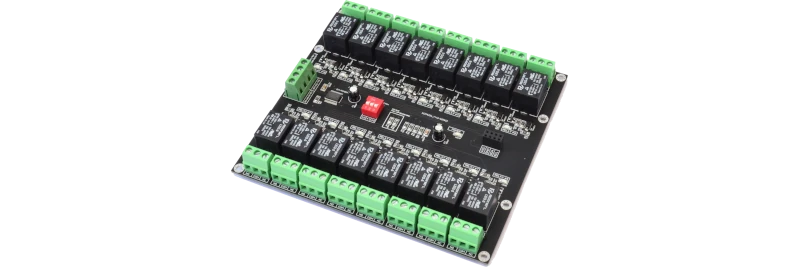
In order to use this board with a Raspberry PI you need a logic level shifter! See connecting topic
Information
The IOT Electronic 16 Channel I2C Solid State Relay Module provides 16 isolated channels for Arduino and Raspberry projects, supporting 100-240V AC control.
This IOT Electronic 16 Channel I2C Solid State Relay Module offers robust control for your microcontroller projects. Designed for compatibility with Arduino, Raspberry, and other microcontrollers, it provides 16 isolated solid state relay channels.
Key Features
- Control 16 independent channels using an I2C interface.
- Built around the efficient PCF8575 I2C expander chip.
- Designed for compatibility with Arduino, Raspberry, and various microcontrollers.
Device Specifications
- PCB Board Dimension: 210mm x 72mm
- Compatibility: DRG-01 DIN rail plastic holder
- Isolation: Full opto and air isolation from high voltage
- Operation DC Voltage: 3.3V and 5.0V
- Maximum Current @5.0V: 450mA
- AC Controlling Voltage Range: 100…240VAC
- AC Voltage Frequency Range: 50…60Hz
- Minimum AC Current per Channel: 30mA
- Maximum AC Current per Channel: 2A
- I2C Device Slave Address: Changeable
- Expandability: Connect up to 8 devices to one I2C bus, controlling up to 128 channels
- Indicators: Red LED indicators for each SSR relay channel
This versatile relay module simplifies projects requiring multiple high-voltage switching capabilities. Its I2C interface allows for easy integration and expansion, enabling control of up to 128 channels with multiple modules. The opto and air isolation ensure safety and reliability when dealing with AC loads up to 240V, making the IOT Electronic 16 Channel I2C Solid State Relay Module an excellent choice for demanding applications.
Ideal for
- Makers and hobbyists working with Arduino and Raspberry Pi.
- Automation projects requiring multi-channel AC switching.
- Industrial control applications needing isolated relay outputs.
- Projects where space-saving and expandability are crucial.
- Electronics enthusiasts building custom control systems.
16 Channel I2C Electromagnetic Relay Module PCF8575
Connecting to the PI
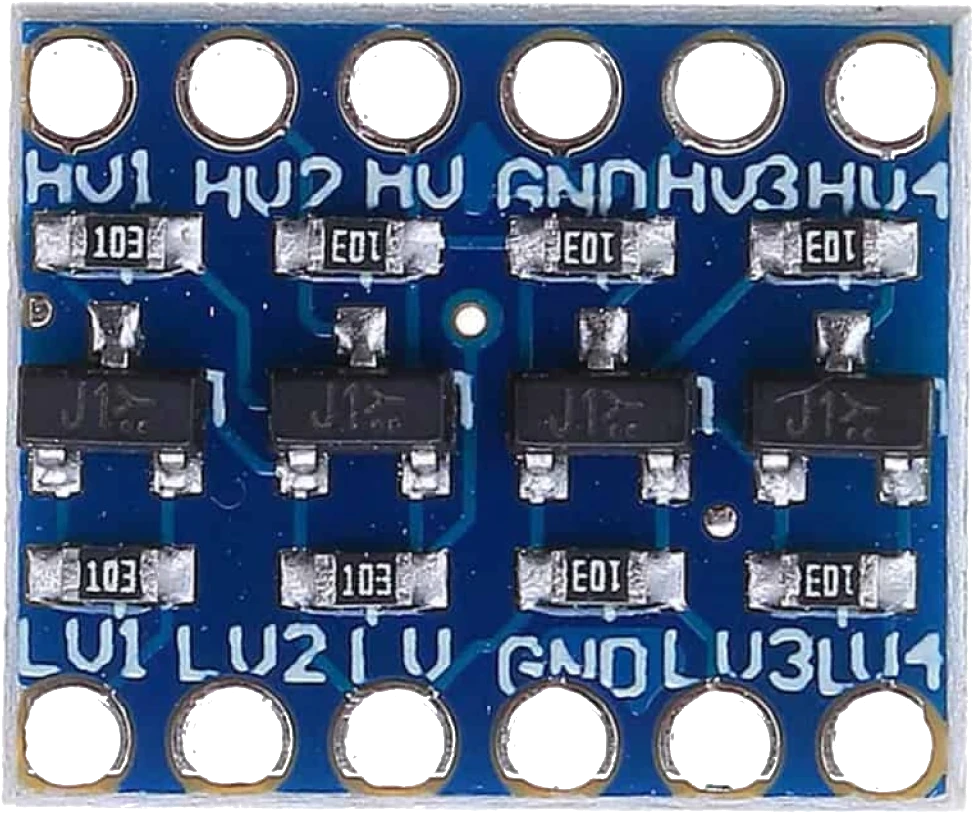 In order to use this board stable, you need to use a
 logic level shifter. Just search for it, and you will find some. As the 3.3 volt bus of the Raspberry PI is not powerful enough the power the board.
- Connect the I2C bus from the Pi to the lower voltage side of the level shifter by using 2 channels. And use the 3.3 volt from the Raspberry PI as LV of the lower voltage side and use any ground pin.
- Than connect the relay board to the logic level shifter. Use the opposite connectors of the low side part. So that two channels are used on both sides. And connect the power and ground in the high voltage side.
- The final step is to connect the board on the other side (green screw terminal) to a 5 volt power source. This can just be the 5 volt bus of the Raspberry PI. Or use an external power source. Without this, the board will fail after toggling 3 relays on.
The above setup does work, but it is advised to use an external 5 volt power device at step 3. The board can draw more than 50% of the Pi power!
Setup
In order to use the 16 Channel I2C Electromagnetic Relay Module IoT use the following settings:
Mandatory
- Hardware
- GPIO
- Address
- Enter the IO Expender type, the relay number (starting at 1), and then the I2C address with optional I2C bus number:
pcf8575-1,0x27,3
Other settings can be found at the relay setup information